|
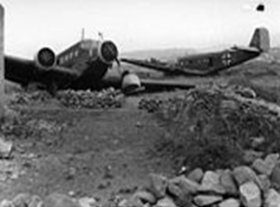
The guys had made a damn good job of fixing the airplane, but they didn't have any paint to paint over the swastika roundels on the side of the airplane. I didn't realize that I was to be the target, and there was a flare path in full operation.
There were aircraft taking off this beastly runway and that's why it was lighted up. I came in at tree top level and then it struck me that there were swastikas on the airplane. I saw one chap take off and I dragged this thing to the runway with the three motors flat out. I saw a chap taxiing out, so I went woops over his head and slapped the thing down onto the runway and ran to the far end of the runway, turned off and switched off.
Out came the security blokes and formed a circle around us with their rifles ready. I opened the door and I held up my hands and I cried out: don't shoot, don't shoot, onse mense, don't shoot. They turned out to be quite nice blokes.
I bummed full tanks of petrol from them and set off for Marble Arch (log entry: 24th - 3.20 hrs). I didn't want to fly across the sea again to Benghazi, so I went to El Adam (log entry: 24th - 3.05 hrs) instead. I landed at the depot without movement papers, I had nothing. Operations now were far away, but here I was flying a Gerry airplane without any papers.
Anyway, after a lot of talking I talked them into giving me some full tanks and we set off for the next place where we filled up with petrol. I nearly signed CS Coppen pp General JC Smuts. I could have gone straight across the desert, but I didn't fancy that, so I went round to Mersa Matruh (log entry: 24th - 1.50hrs).
At Mersa Matruh I battled to get petrol out of them, then I landed at El Maza (log entry: 25th - 2.15 hrs), the aerodrome closest to Cairo. There the captain was on the ball and here is this ruddy Gerry plane again, and they wanted to inspect it. Well we had 18 rifles, 18,000 rounds of ammunition and 56 motorcar tyres and this is not good for us.
Luckily they had a T-hanger in which I hurriedly parked it, so we piled out of the airplane and I locked the door. They started to get a bit sticky. I went to Vilavit where they had a staff officer, an attorney in the Air force, which I knew well. I said: "look man, I've got a few problems - I want flight authorization for the airplane and a movement order for 18 blokes back to the Union."
He was a first class bloke and made out the necessary documentation. I went back to El Maza where I showed it to the captain. I managed to bum full tanks of petrol from their Air force and we set off on a rather long hop. I worked out my ground speed when we hit Africa on the first hop at exactly 88 mph instead of the 120 mph that I had calculated.
We landed at Luxor (log entry: 25th - 2.50 hrs). Luckily Luxor was a training base for the SAAF and I managed to get some petrol out of them. The next day we went from Luxor to Wadi Halfa (log entry: 30th - 2.40 hrs). The landing strip was snow white and when the sun is overhead the glare is so intense that you don't know if you are 5 or 50 feet off the ground. So they put a row of drums out but you really do not know where the ground is. It's like landing on clear calm water.
Col. Frank Coetzee, who copped me and had him also a JU 52 rebuilt, thought that he was near the ground. He held off, and held off and crashed into the runway and broke his bloody neck. Frank and I were buddies for many years.
The next day it was Wadi Seinda (log entry: 26th - 3.50 hrs) near Khartoum. There I got petrol out of the Royal Air force by filling in forms in triplicate and signing pp. General J.C. Smuts again. The next leg was to Wadi Malikal (log entry: 26th - 4.20 hrs). At Wadi Malikal we had quite a bit of drama. It is a long narrow tarmac strip in the middel of the Nile with little mutton bones on both sides.
I didn't say that we were 18 blokes and a hell of a lot of extra weight on board. The Airways were flying these planes with 12 passengers and luggage only, so we were grossly overloaded and by the time I reached Wadi Malikal the planes axles had started to bend quite a bit, and the brake linings were finished, so I had very little brakes.
I had to turn on the runway and slapped the outside motor open to skid around; she accelerated and went off the bloody mutton bone down into the bog. The District Commissioner and the old DC helped us out with 300 prisoners who picked the plane up bodily and put it on the tarmac. I had to fight the RAF again for petrol and got my tanks full.
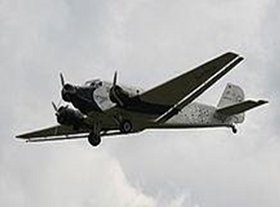
We went to Juba (log entry: 27th - 2.5 hrs), then Kisumu [Kenia] (log entry: 27th - 3.20 hrs) where we had some drama. We had to cross the Ruwenzori Mountains (9000 ft high). That was a gut of an altitude for these old Junkers. With wide open throttles I had about 10 goes at it but couldn't make it. Back then to Kisumu for fill up of tanks and I had another go at it early the next morning when the air was nice and dense and we managed to reach 9000 ft and over the mountains. We landed at Tabora (log entry: 28th - 3.10 hrs). Tabora is stuck in the damn forest and was difficult to find.
From there we flew to Kasama (log entry: 28th - 3.25hrs) which have a very short runway. I came in over the trees and slapped the thing down and it ran and it ran and the trees were coming up and the damn thing wasn't going any slower. So I slapped the outboard engine open and started a ground loop which was very effective but it put the wing in the bloody ground.
It didn't really damage the wing, but the tyre. So off I went to the old DC again and he came out with a whole lot of munts. We packed them along the wing and we piled on munts until the wing tipped up, allowing us to change the tyre. That was Kasama. From there we flew to Lusaka (log entry: 29th - 3.20 hrs) and then to Bulawayo (log entry: 31st - 2.45 hrs) without problems.
The trouble now was coming into the Union. The CO in Pietersburg, Carpie Martin, was an old friend of mine. I explained my problem to him when we landed at Pietersburg and he said: OK off you go. It cost me two tyres.
I had to get rid of the tyres before we hit Swartkops in Pretoria. I told the mechanics to take the bloody door off and put it inside the plane. We took off from Pietersburg, with a great big gulping hole in the side of the plane. My brother was managing a large Estate on the Springbok flats.
Tyres were raining down from the aircraft, bouncing on the ground and leaping into the air in all directions on this Estate. The neighbor de Beer's tractor driver got such a freight that he jumped off the tractor and ran away. The tractor ploughed through the fence and came to rest all buggered against some trees. The neighbor got hold of the police and complained about the bastards in uniform getting tyres and they can't. That caused me some drama later on.
I landed crosswind at Swartkops and ran right to the far side over the ridge away from the pilot on duty. The blokes tried to put the door back on quickly, but the plane was bent and it would not fit. We piled out the rifles and ammunition into the grass. We would come back later to pick it up.
When we stopped on the tarmac, everybody was very pleased to see us except the Health people, because they couldn't spray the Junkers because it was wide open. I explained to them that the plane was bent and that we had to take the door off. So, I got away with it.
I had to fly the Junkers to Germiston (31st) and thought I had got away with everything, but the police got hold of me and I had to explain everything. I had to do several trips to bring the tyres back, but my brother got away with a whole lot.
At the end of the war I went to Military Intelligence to clear myself and I saw that my file was about 3 inches thick. They had a look through my file and I was court marshaled. Gen. Brink and I were great buddies... the last letter in the file read: In view of this officer's distinguished war record... That was the end of an incredible journey.
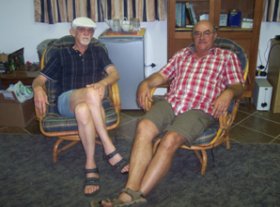
Thank you, Bob - we salute you on behalf of the nation!
|